


Use a sinking fund for a cost you can reasonably anticipate, even if it comes only once a year. Use an emergency fund for an unplanned financial shock that your regular budget cannot absorb. The distinction is about whether the expense was foreseeable and assigned money, not whether it feels important or unpleasant.
The CFPB describes emergency savings as a cash reserve for unplanned expenses such as a repair, medical bill, or loss of income. The FDIC also recommends saving for anticipated expenses separately. “Sinking fund” is a planning label here, not a special bank account or a regulated product.
Pick a bucket before you pay
| Situation | Likely bucket | What to check |
|---|---|---|
| Annual insurance premium with a known renewal month | Sinking fund | Update the target when the renewal notice changes |
| Routine car maintenance you can schedule | Sinking fund | Estimate based on a quote or prior costs |
| Sudden essential car repair after a breakdown | Emergency fund, if ordinary cash cannot cover it | Confirm the repair and its urgency first |
| Job income stops unexpectedly | Emergency fund for essential costs | List what must be paid and when |
| Holiday gifts you decide to buy | Planned spending or sinking fund | Reduce or postpone if funds are short |
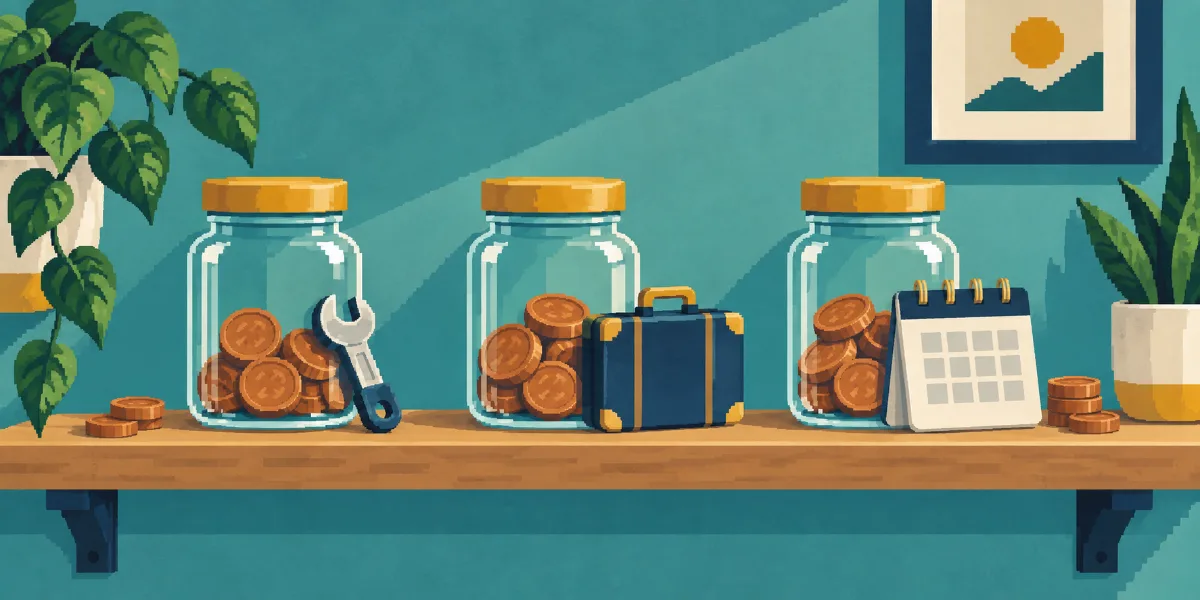
There are gray areas. A tire wears out predictably, but a blowout tomorrow may be an immediate surprise. If your maintenance fund covers the bill, use it; if the necessary repair exceeds what is assigned there, the gap may be a reasonable emergency use. Write down which bucket paid each portion and plan to rebuild it. An elective upgrade is not automatically an emergency merely because its price is higher than expected.
One balance, distinct assignments
Illustrative example, not a household benchmark: Imagine $2,400 in one savings account. Your ledger assigns $900 to an upcoming insurance premium, $500 to planned travel, and $1,000 to unplanned costs. The assignments total $2,400. If a necessary $700 repair arrives unexpectedly and the checking balance cannot cover it, using $700 from the emergency assignment leaves $300 for emergencies. The account would then contain $1,700, including the untouched $900 and $500 assignments.
You cannot say you have $2,400 for emergencies while still promising $1,400 of that balance to the two planned costs. That would count the same dollars twice. If you decide to redirect planned money because the shock is larger than your emergency reserve, record that as a conscious change: the planned expense now has a shortfall, and its deadline may need to change.
What if both buckets are too small?
- Check timing and necessity. Is the bill due now, and can a lower-cost repair or payment schedule solve the immediate problem? Ask about fees and terms before agreeing.
- Protect essential bills first. Do not transfer money from checking if it is needed for rent, groceries, utilities, or a payment that clears before the next payday. The CFPB advises checking balances before automatic savings transfers to avoid overdrafts.
- Reassign visibly if needed. Note the amount moved, which planned goal is delayed, and the new amount to save. Avoid presenting a reclassified dollar as new savings.
- Restart at a feasible level. A small contribution you can sustain is more useful than an ambitious amount that repeatedly causes a shortfall.
For the next known expense, use a due-date sinking fund plan. For a shock, decide what belongs in your essential-expense cushion and, after any withdrawal, set a realistic refill schedule. The FDIC’s guidance to specify goals and save regularly supports both tracks, but only your actual cash flow can set their pace.
Sources and notes
- CFPB, An essential guide to building an emergency fund
- FDIC, Starting Small Can Lead to Big Savings
- FDIC, Saving for the Unexpected and Your Future
Source links and illustrative calculations checked on 2026-09-22 (UTC). This article was prepared with AI-assisted research and drafting, followed by source and calculation checks. This is not an independent human or professional review. Read our editorial policy or report a correction.

