


Is an appliance’s running cost worth changing? For an appliance that draws a fairly steady amount while running, estimate its added energy cost as watts ÷ 1,000 × operating hours per day × number of days × your applicable price per kilowatt-hour. This estimates the energy portion associated with that use, not your entire electric bill or a guaranteed saving from unplugging it.
For steady-draw use, enter watts, actual operating hours per day, days and your applicable price per kWh below. For a refrigerator or other cycling appliance, do not put 24 hours next to its rated watts and call the result its actual consumption. For a meter reading already in kWh, use the measured-energy method later in this guide instead; do not multiply that reading by watts.
Appliance electricity estimate
Incremental energy only: watts × hours per day × days ÷ 1,000 × price per kWh. Excludes fixed charges and does not model cycling, standby use, tier changes, or taxes. Use measured average watts or actual active hours for cycling appliances. This is not a guaranteed bill saving.
US dollars. This tool calculates in your browser only. It does not send, store, or log your entries. Inputs start blank. Load example fills hypothetical figures without calculating; examples are not prices or recommendations. Required fields are labeled below. Electricity rates may include more than two decimal places.
If you are budgeting for a portable heater, use the 1,500-watt space heater cost guide for hourly and monthly examples, thermostat-cycling assumptions, and safety notes.
Where do you find watts, run time and your kWh rate?
- Power: Look for watts on the appliance’s label or manual. That number may describe a maximum draw, not average operation across modes. For a variable-speed appliance, a measured energy reading over representative use is better.
- Run time: Count the time the appliance actually draws the stated power, not just the time it remains plugged in. Write down typical days of use separately from unusual days.
- Energy price: Find the per-kWh charge applicable to additional usage on your utility bill or tariff. A bill’s total divided by kWh can blend fixed charges, taxes and other items; it may not be the marginal price for one more kWh. Time-of-use or tiered rates can also make a single-price estimate rough.
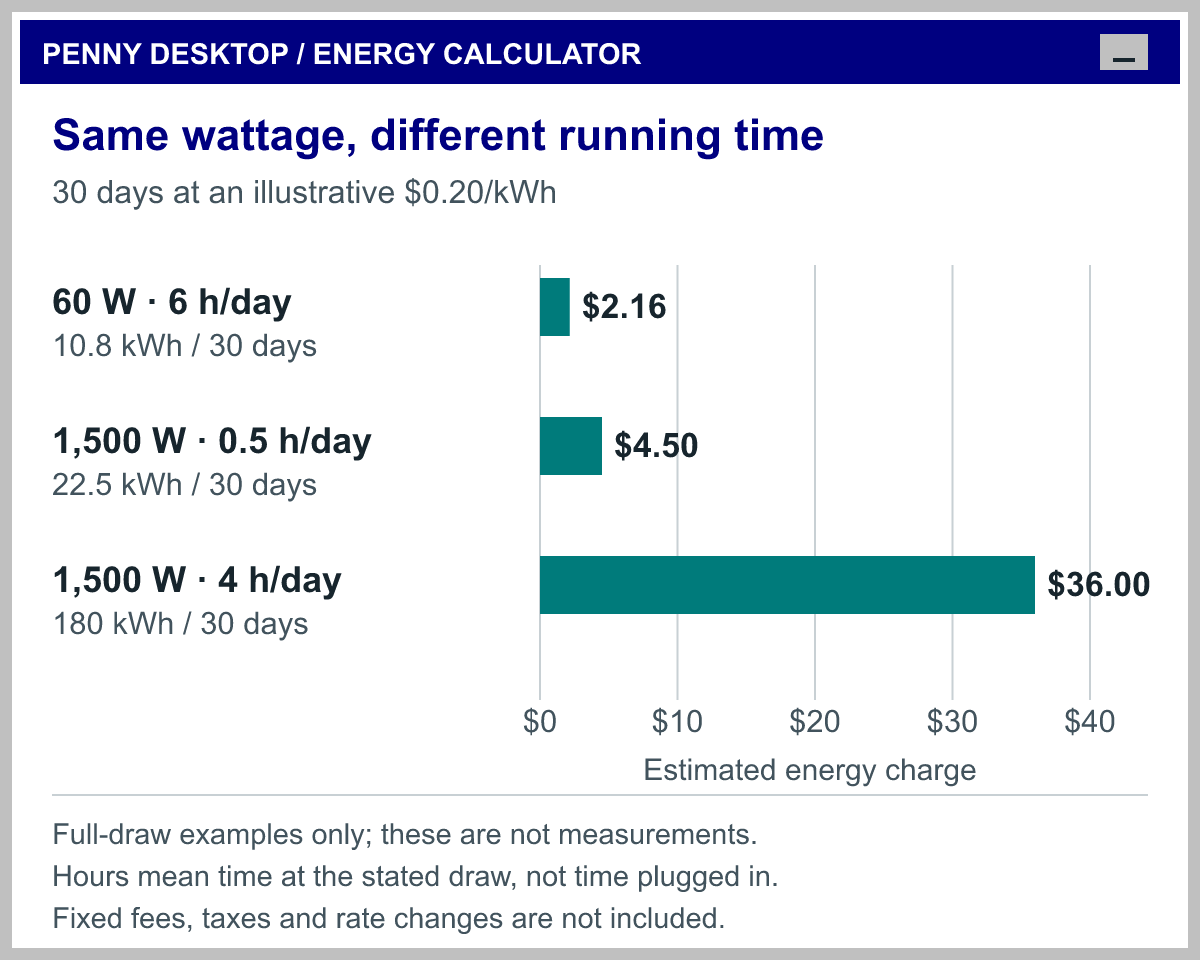
| Stated draw | Full-draw hours/day | Energy, 30 days | Energy charge |
|---|---|---|---|
| 60 W | 6 | 10.8 kWh | $2.16 |
| 1,500 W | 0.5 | 22.5 kWh | $4.50 |
| 1,500 W | 4 | 180 kWh | $36.00 |
A kilowatt-hour is an amount of energy: using one kilowatt for one hour equals one kWh. The Department of Energy’s Energy Saver guide describes using an appliance’s wattage, utility rate and yearly use to estimate operating cost. An estimate is only as good as those inputs.
What does a hypothetical fan cost to run for a month?
Inputs: suppose a 60-watt fan runs at roughly that draw for six hours a day on 30 days, and the applicable energy price is an illustrative $0.20 per kWh, not an actual utility rate.
Formula and result: energy use is 60 ÷ 1,000 × 6 × 30 = 10.8 kWh. The estimated incremental energy charge is 10.8 × $0.20 = $2.16 for that period.
What to check: if the fan has other speeds, its draw changes or the rate varies by hour, measure or split the calculation into separate segments.
What if you already have a measured kWh reading?
If a suitable meter records a hypothetical 3.6 kWh over 3 representative days, estimate 30-day energy as 3.6 ÷ 3 × 30 = 36 kWh. At the same illustrative $0.20/kWh, that is $7.20 in energy charges.
The meter reading already includes changing power draw over time: do not multiply by watts again. Scale only if those days represent the period you want to estimate; seasonal use, settings, occupancy or an unusual day can change the result.
| Input or step | Value |
|---|---|
| Meter energy over representative period | 3.6 kWh over 3 days |
| Average daily energy | 3.6 ÷ 3 = 1.2 kWh/day |
| 30-day projection | 1.2 × 30 = 36 kWh |
| Energy charge at illustrative rate | 36 × $0.20 = $7.20 |
Why doesn’t rated watts × 24 hours work for a refrigerator?
A refrigerator is powered continuously but its compressor cycles, and defrost and other loads change consumption. The nameplate’s rated wattage times 24 hours times the days in a month is therefore not a sound estimate of its actual billed energy.
A plug-in energy meter rated for the appliance, read over representative days, gives measured kWh. Follow the device’s safety instructions; do not use an unsuitable meter for a high-power or hardwired appliance.
For a model you are considering, use its EnergyGuide estimated annual kWh as a comparison starting point, then multiply by your own applicable rate and adjust expectations for actual use. The FTC explains that refrigerators are among products covered by EnergyGuide labels, which show standardized estimated annual energy costs or efficiency information.
The DOE also provides a refrigerator and freezer energy-rating lookup for estimated consumption ranges. Even the ENERGY STAR refrigerator comparison warns that actual savings vary with use, upkeep and other factors.
When is the watts-times-hours estimate the wrong tool?
- Cycling appliances such as refrigerators: use measured kWh or an EnergyGuide estimate instead of rated watts × 24 hours.
- Variable-speed or multi-mode devices: the label’s watts may be a maximum draw, so measure representative use or split the calculation by mode.
- Time-of-use or tiered rates: a single price per kWh makes the estimate rough.
- Replacement decisions: the energy estimate alone is not a payback calculation without purchase and installation costs.
What should the estimate change in your decision?
If you are choosing whether to run an optional device, compare its incremental kWh with a realistic change in usage. If you are considering replacing an appliance, compare purchase and installation costs as well as operating energy; the energy estimate alone is not a payback calculation. Keep fixed fees out of the incremental estimate unless a tariff change really applies.
For a broader household decision, include electricity alongside other out-of-pocket items in a work-from-home cost comparison. When buying home equipment, separate purchase costs from recurring bills with a first-apartment essentials budget.
The next useful step is to copy a representative bill’s applicable rate and either time the appliance’s actual operation or obtain measured kWh before entering numbers.
Quick decision checklist
- Copy the per-kWh charge for additional usage from a representative bill or tariff, not the bill total divided by kWh.
- Time the hours the appliance actually draws its stated power, not the hours it stays plugged in.
- Use measured kWh or an EnergyGuide estimate for a refrigerator or other cycling appliance.
- Do not multiply a kWh meter reading by watts again.
- Add purchase and installation costs before treating an energy estimate as a reason to replace equipment.
Sources and notes
- U.S. Department of Energy, Energy Saver Guide, 2022
- U.S. Department of Energy, Refrigerator and Freezer Energy Rating Search Tool
- FTC, EnergyGuide Labeling FAQs
- ENERGY STAR, Flip Your Fridge Calculator
Source links and illustrative calculations checked on 2026-09-22 (UTC). This article was prepared with AI-assisted research and drafting, followed by source and calculation checks. This is not an independent human or professional review. Read our editorial policy or report a correction.
Revision note, 2026-09-24: Added an original calculation chart and reviewed the arithmetic for this revision. The original source-review date remains 2026-09-22; this note does not claim a new source review or an independent human or professional review.

