


A 1,500-watt space heater uses 1.5 kilowatt-hours (kWh) for each hour it actually draws 1,500 watts. At an illustrative electricity price of $0.20 per kWh, that is $0.30 per full-power hour, $2.40 for eight full-power hours, or $72 for 30 days of that use.
Your applicable utility rate and the heater’s active run time determine your estimate. These are energy charges, not a forecast of your entire bill.
Eight hours is a calculation example, not advice to leave a heater running while asleep or away. The U.S. Consumer Product Safety Commission (CPSC) says never to leave a portable heater operating unattended or while sleeping.
How do you calculate your heater’s electricity cost?
In the calculator below, enter 1500 for watts, your full-power operating hours per day, the number of days, and your applicable dollars per kWh. For example, 20 cents per kWh is 0.20, not 20.
Appliance electricity estimate
Incremental energy only: watts × hours per day × days ÷ 1,000 × price per kWh. Excludes fixed charges and does not model cycling, standby use, tier changes, or taxes. Use measured average watts or actual active hours for cycling appliances. This is not a guaranteed bill saving.
US dollars. This tool calculates in your browser only. It does not send, store, or log your entries. Inputs start blank. Load example fills hypothetical figures without calculating; examples are not prices or recommendations. Required fields are labeled below. Electricity rates may include more than two decimal places.
Use the heater’s actual setting and label rather than assuming every portable heater is rated at 1,500 watts. For a device that cycles, see the active-time example below. The calculator does not independently measure its power or thermostat behavior.
How the calculator handles inputs and rounding
Use 1 day for a daily estimate or 30 days for the monthly examples here. Results stay in your browser; the tool does not send or store your entries.
What would 1, 2, 4, or 8 full-power hours a day cost?
Inputs (hypothetical): 1,500 watts at full power, 4 hours a day, 30 days, $0.20 per kWh. Formula: 1,500 ÷ 1,000 × 4 × 30 = 180 kWh. Result: 180 kWh × $0.20 = $36 for the month. What to check: whether the heater really draws full power for all of those hours, and which rate applies to your additional kWh.
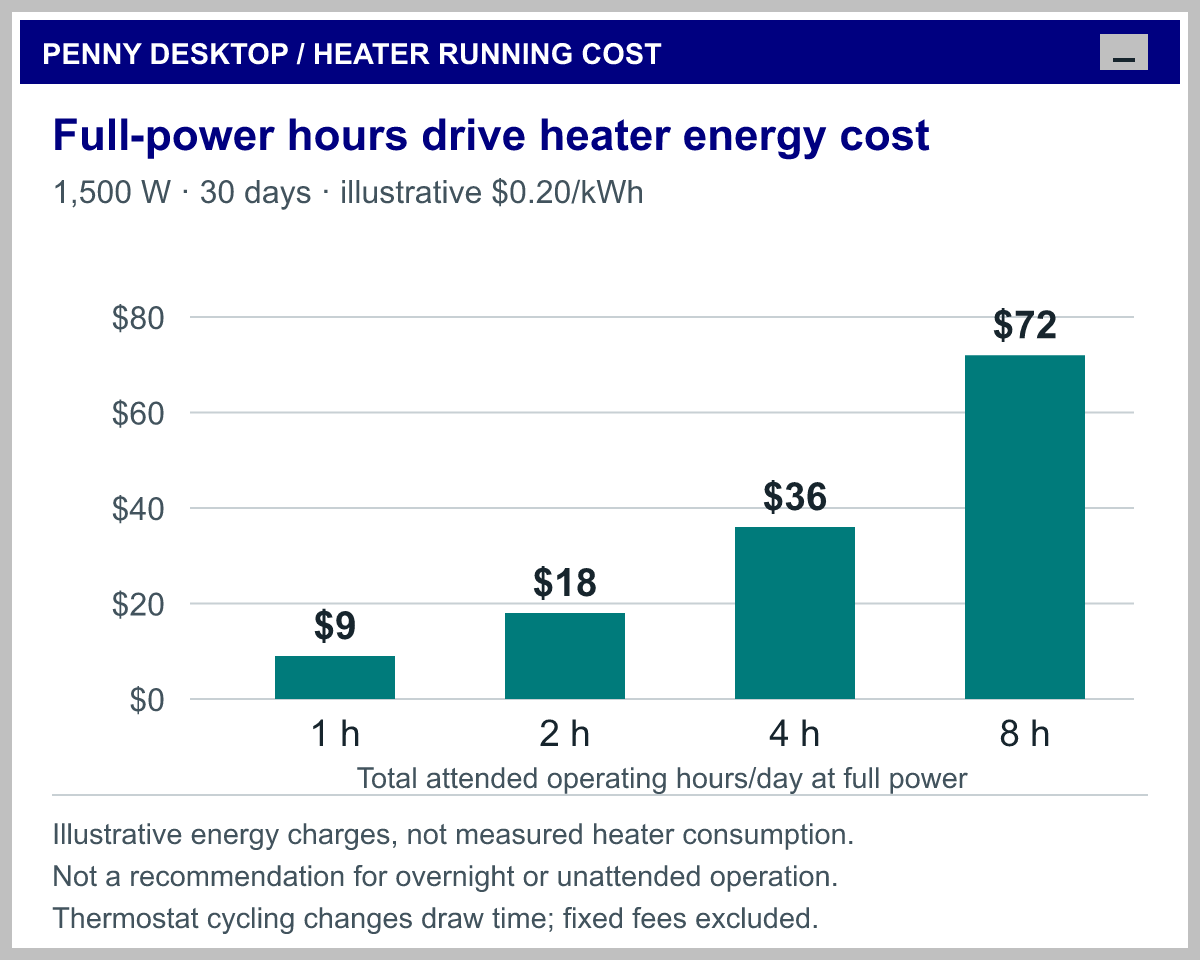
| Full-power hours per day | kWh per day | Energy cost per day | Energy cost for 30 days |
|---|---|---|---|
| 1 | 1.5 | $0.30 | $9.00 |
| 2 | 3 | $0.60 | $18.00 |
| 4 | 6 | $1.20 | $36.00 |
| 8 | 12 | $2.40 | $72.00 |
Which electricity rate should you use?
Find the charges that apply to additional kWh on your utility bill or tariff. A fixed monthly service fee normally does not increase just because you run the heater.
Dividing the whole bill by total kWh can mix fixed fees with usage charges and may not represent the price of additional electricity. Taxes, usage tiers, and time-of-use pricing can also change the result.
| Rate per kWh | Cost per active hour | 30 days at 4 hours/day | 30 days at 8 hours/day |
|---|---|---|---|
| $0.10 | $0.15 | $18.00 | $36.00 |
| $0.20 | $0.30 | $36.00 | $72.00 |
| $0.30 | $0.45 | $54.00 | $108.00 |
| $0.40 | $0.60 | $72.00 | $144.00 |
If prices vary by time, calculate each period separately and add the costs. For a made-up example, six active hours at $0.15/kWh plus two active hours at $0.30/kWh cost (1.5 × 6 × $0.15) + (1.5 × 2 × $0.30) = $2.25 per day, or $67.50 for 30 identical days. This is not an actual utility tariff.
Why might eight hours switched on not equal eight full-power hours?
A thermostat may switch the heating element on and off. Suppose a heater is switched on for eight attended hours per day but draws 1,500 watts for only half that time. That is four full-power hours: 1.5 × 4 × 30 = 180 kWh, costing $36 at the example $0.20/kWh rate.
The 50% on-time is an assumption, not a typical or guaranteed duty cycle. This simplified case also leaves out any fan or standby consumption while the element is off.
Room conditions, thermostat controls, and device design can change actual use. If you cannot establish active run time, keep the continuous-on result labeled as a scenario rather than presenting it as measured consumption.
Does a 750-watt low setting cost half as much?
For the same active duration and rate, yes in this power-based calculation. A hypothetical 750-watt setting used four hours per day for 30 days costs $18 at $0.20/kWh, compared with $36 at 1,500 watts for that same time. Check your model’s label or instructions; not every heater has these settings.
That does not mean choosing low power always cuts the cost of warming a room in half. Running 750 watts for eight hours uses the same 6 kWh as running 1,500 watts for four hours. Different run times can cancel the apparent saving.
Which safety rules apply whatever the cost?
Follow the heater’s instructions and CPSC’s portable-heater guidance:
- Keep all sides at least three feet from combustible items, such as curtains, bedding, and furniture.
- Plug the heater directly into a wall outlet, not an extension cord or power strip.
- Place it on a stable, level surface and never leave it operating unattended or while sleeping.
- If the heater’s cord or plug is hot, disconnect the heater and contact an authorized repair person. If any part of the outlet is hot, stop using the heater and contact a certified electrician.
A cost table is not a safety rating or a recommendation to operate for a particular number of hours.
Is it cheaper than central heating?
The heater’s wattage alone cannot answer that. You would need the actual energy use and rates for both systems, which rooms are heated, the hours involved, and any central-heating use that really changes. If central heating continues unchanged, adding a space heater adds electricity use rather than automatically saving money.
When does this estimate not fit?
- You do not know the active run time. A thermostat-controlled heater may draw full power for only part of the time it is switched on, so a continuous-on figure is a scenario, not measured use.
- Your rate changes by time or usage tier. Calculate each period or tier separately instead of using one rate.
- You want a whole-bill forecast. Fixed service fees, taxes and other household use are outside this energy-charge estimate.
- You are comparing with central heating. Wattage alone cannot answer that; you need both systems’ actual use and rates.
What formula does this estimate use?
The calculation is watts ÷ 1,000 × active hours per day × days × applicable dollars per kWh. The U.S. Department of Energy’s Energy Saver guide describes estimating appliance operating cost using wattage, local electricity prices, and use.
For other devices and guidance on measured kWh or appliances that cycle, see the broader appliance electricity cost guide and calculator. Its calculator accepts watts and operating time, not a direct kWh entry.
Before acting on an estimate, write down your heater’s actual setting, a realistic attended operating schedule, and the applicable rate from your own bill. Change one assumption at a time to see which uncertainty matters most.
Quick decision checklist
- Read the heater’s label for the watts at the setting you actually use.
- Estimate full-power hours, not just hours switched on, for attended use only.
- Use the rate your bill charges for additional kWh, not the whole bill divided by total kWh.
- Calculate time-of-use or tiered periods separately and add them.
- Follow the CPSC safety rules whatever the cost result shows.
Sources and notes
- U.S. Department of Energy, Energy Saver Guide, July 2022, p. 30 (PDF p. 34), appliance operating-cost inputs
- U.S. Consumer Product Safety Commission, 7 Highly Effective Portable Heater Safety Habits
Prepared on September 24, 2026. Source documents and illustrative calculations checked on 2026-09-24. This article was prepared with AI-assisted research, drafting, and calculation checks. This is not an independent human or professional review. Rates are hypothetical, and no bill saving is promised. Read our editorial policy or report a correction.

