


Is a warehouse club membership worth it for your household? It pays for itself only if the savings on items you would otherwise buy exceed the annual fee and the extra costs of shopping there. Use the same usable basket, not a cart full of attractive bulk prices.
A membership fee already paid and nonrefundable is a different decision from whether to renew next year.
For a new membership or renewal, enter the upcoming fee, expected savings on a matched usable basket, and extra trip costs below. Compare the result with your planned comparable visits. Treat an already-paid, nonrefundable fee separately when deciding on the next trip.
Membership break-even visits
Use verified savings on the same basket, not advertised discounts. Include extra travel, waste, or other incremental costs per visit. Assumes the same net saving on every visit during the annual membership period. With no fee, costs start tied: a visit can save money, keep costs tied, or add cost depending on the net saving. No rewards or membership refund is assumed.
US dollars. This tool calculates in your browser only. It does not send, store, or log your entries. Inputs start blank. Load example fills hypothetical figures without calculating; examples are not prices or recommendations. Required fields are labeled below. Dollar entries allow up to two decimal places.
NIST recommends unit prices for comparing quantities, while EPA notes large-quantity promotions save money only when the food is used. Neither source establishes that any specific club’s prices beat your alternatives. You have to verify the actual basket, fees, and travel for your area.
How do you build a like-for-like club trip?
Inputs: for a hypothetical renewal decision, imagine an annual fee of $60. A planned basket of the same usable items is $72 at the ordinary store and $65 at the club. These illustrative receipts are not current brand prices.
The $7 basket difference is measured after any ordinary-store discounts you can actually use, and before extra club-specific costs.
Suppose the club trip adds $2 in travel cash and you also buy a $1.50 club-only add-on that you would not have bought elsewhere and do not use. That add-on is outside the $65 matched basket, not a second charge for a wasted item already in it.
If unwanted quantity is already included in the $65 club receipt, adjust the usable basket comparison instead of adding its value twice.
How many visits does it take to cover the fee?
Formula: per-visit net benefit is the matched basket advantage minus extra club costs. Divide the annual fee by that net benefit and round up to whole visits.
| Step | Calculation | Result |
|---|---|---|
| Matched basket advantage | $72 less $65 | $7.00/visit |
| Extra club costs | $2 travel plus $1.50 add-on | $3.50/visit |
| Net benefit before annual fee | $7 less $3.50 | $3.50/visit |
| Visits to cover $60 fee | $60 divided by $3.50, round up | 18 visits |
| Planned comparable visits | Visit savings before fee | Net benefit after fee |
|---|---|---|
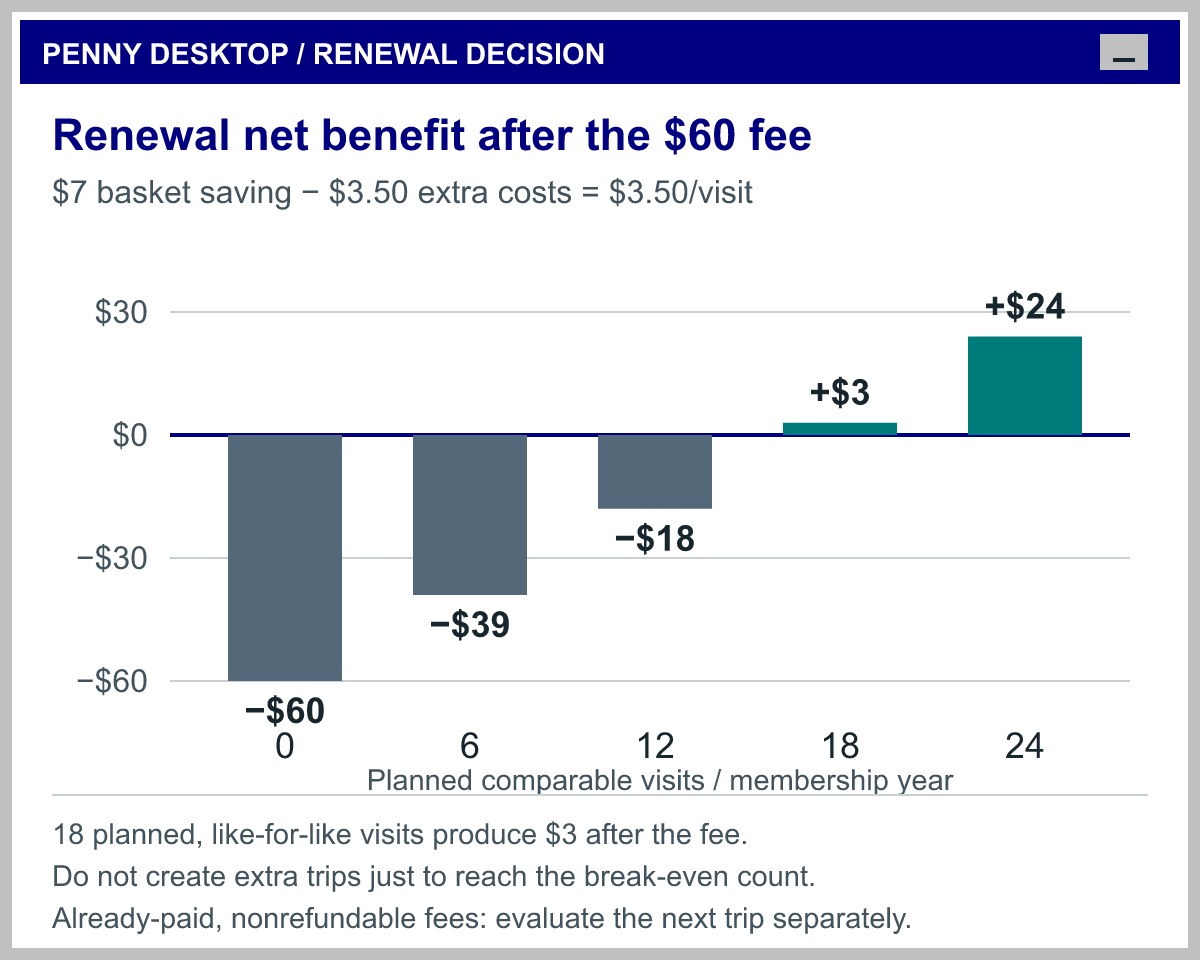
| 0 | $0.00 | −$60.00 |
| 6 | $21.00 | −$39.00 |
| 12 | $42.00 | −$18.00 |
| 18 | $63.00 | $3.00 |
| 24 | $84.00 | $24.00 |
Result: at 12 comparable visits, the $42 trip benefit is $18 short of the fee. At 18 visits, the $63 trip benefit exceeds it by $3. The exact threshold is $60 ÷ $3.50 = 17.142857… visits.
What to check: 18 whole visits cover the fee only if they are planned, like-for-like visits and the assumed $3.50 benefit holds. Do not add unnecessary trips or purchases to chase that count. If per-visit net benefit is zero or negative, more of the same visits cannot recover the fee.
Are you joining, renewing, or already paid?
- Buying or renewing: Compare the full fee for the upcoming period with likely net benefits during that same period. Do not treat a one-time promotional fee as the ongoing rate.
- Already paid and nonrefundable: Do not allocate the fee to a single decision about tomorrow’s trip. Choose the cheaper marginal trip after extra travel and purchases. Revisit the full annual fee when renewal is optional.
- Shared errands: Count only the additional travel cash attributable to the club. Avoid charging a trip you would make anyway twice.
- Uncertain waste: Test a lower-use case for bulk items. The bulk-use example helps separate usable quantity from printed price.
When is a membership unlikely to pay for itself?
- Per-visit net benefit is zero or negative after extra travel and club-only purchases, so more visits cannot recover the fee.
- You would need extra trips you would not otherwise make to reach the break-even count.
- Bulk quantities go unused, shrinking the usable basket advantage.
- The fee you compared is a one-time promotional rate rather than the ongoing renewal fee.
Before joining, take one ordinary receipt and price the same brands or acceptable substitutes and quantities at the club. Record the fee, trip frequency, cash travel difference, and extra purchases you expect, then calculate.
If the baskets have different package sizes, first use the unit-price method to bring their usable amounts onto the same basis.
Quick decision checklist
- Price one real receipt’s usable items at both the ordinary store and the club.
- Subtract extra travel cash and club-only purchases you would not otherwise make.
- Divide the upcoming fee by the per-visit net benefit and compare with your planned comparable visits.
- Treat an already-paid, nonrefundable fee separately from the renewal decision.
- Test a lower-use case for bulk items before renewing.
Sources and notes
- NIST, Uniform Unit Pricing: Tools for Consumers to Fight Shrinkflation
- EPA, Preventing Wasted Food At Home
Source links and illustrative calculations checked on 2026-09-22 (UTC). This article was prepared with AI-assisted research and drafting, followed by source and calculation checks. This is not an independent human or professional review. Read our editorial policy or report a correction.
Revision note, 2026-09-24: Added an original calculation chart and reviewed the arithmetic for this revision. The original source-review date remains 2026-09-22; this note does not claim a new source review or an independent human or professional review.

